
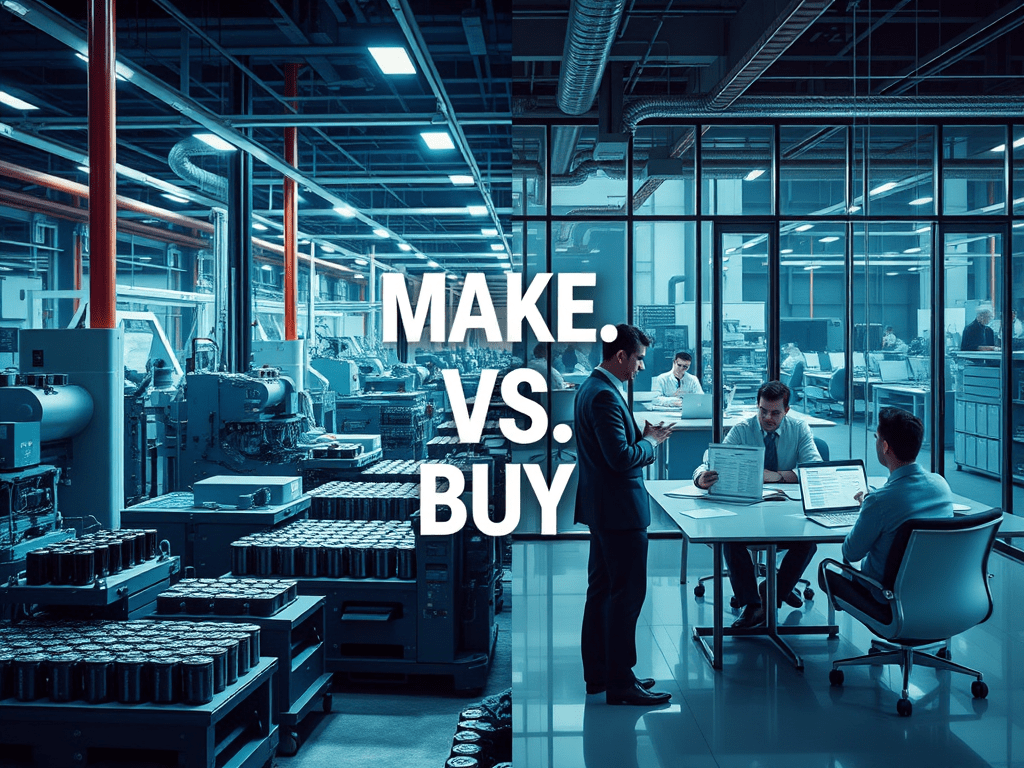
Manufacturing executives face the ultimate relationship question: make it or buy it? Tesla makes batteries in-house for control. Nike outsources for scale. Your spreadsheet says buy, your gut says make. Meanwhile, your supplier just ghosted you like a bad tinder date. Control versus cost, innovation versus convenience, pride vs profit margins
The make-versus-buy debate isn’t just strategy anymore. Welcome to Procurement’s existential crisis where every decision feels like corporate therapy.
What’s your move?
The make-versus-buy question has become the corporate equivalent of asking whether pineapple belongs on pizza — everyone has an opinion, no one agrees, and the debate will never die.
Paul in Procurement will tell you the suppliers love us while Oscar in Ops insists on making everything in-house. Finally, Fiona in Finance, after three days of Excel chaos and arguments over overhead allocation, concludes… “It depends.” (Classic corporate plot twist.)
Tinder Supplier Strategy
Supplier strategy has evolved into a corporate dating game. Paul from Procurement now swipes right on vendors based on sustainability (consistent high on-time deliveries) and innovation (NPIs). I was reading an article on Veridion.com on examples of successful supplier sourcing strategies. Almost 100% of Apple’s direct material spend for manufacturing and assembly is procurement from their top 200 supplier partners that innovate faster than some startups. The goal today is NOT to buy cheap, but to buy smart. This means treating your top suppliers like strong business partners – the kind you can trust in the middle of the night to deliver during a global pandemic.
The Math (sometimes laughable)
Finance and cost accounting crunch numbers doing labor cost comparisons, logistics cost, depreciation and maintenance. On the other hand Ops leaders care about plant capacity. In between all this chaos, someone in corporate strategy reminds everyone that “synergy” is critical – a term strategically vague to the point any decision could be justified.
The truth is smart play is a hybrid strategy. Businesses keep core competencies close to the plant and outsource non-critical components to the supplier partners. It’s like cooking at home because you want to eat healthy, but don’t feel guilty door dashing dessert.
The bottom line
Make Vs Buy is less about machine and money but more about control, trust and avoiding Monday-morning regret. Sometimes it’s cheaper to make, sometimes smarter to buy. The funny part? No matter how good the analysis, the first time OTD (On time delivery) takes a nosedive, it’s inevitable to hear “we should have done it ourselves.”
In the world of business strategies and decision making, that’s the one forecast you can always count on.
 ManufAi
Leave a comment