
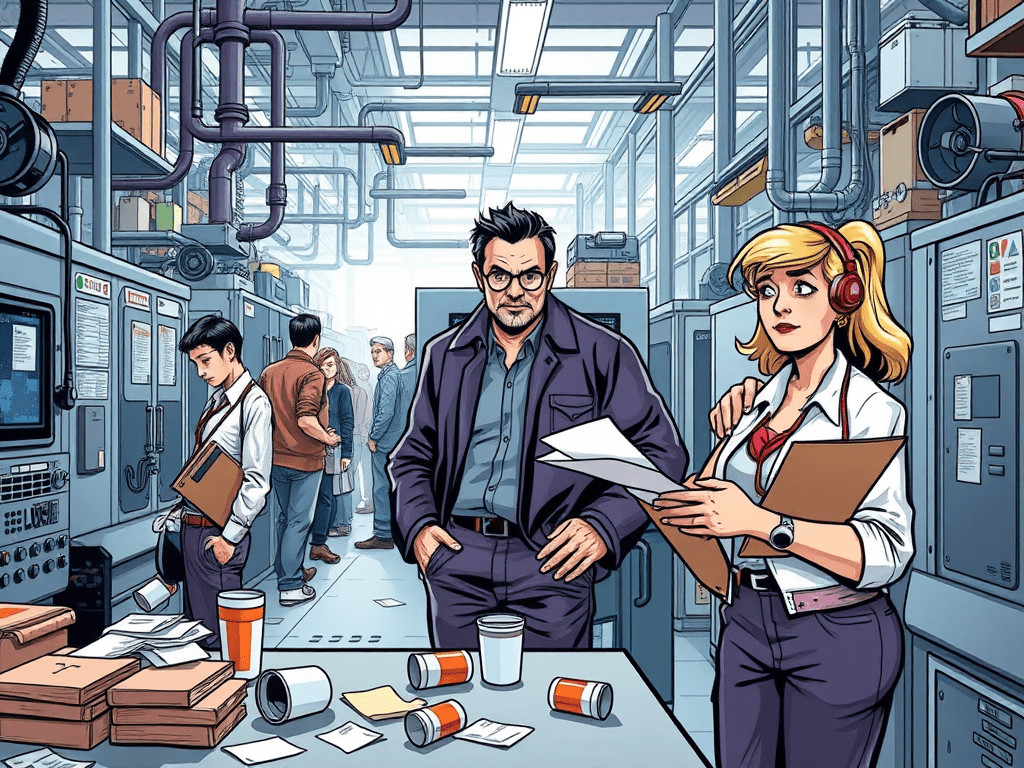
Part 2 of “The Art of the Deal: M&A Strategy and the Smell of Coolant”
You bought the business. You signed the LOI. You survived the data room.
You even pretended to be impressed when the seller said, “Our maintenance guy keeps everything running — he’s basically a magician.”
Now comes the fun part:
Integration.
Also known as: the period where your confidence slowly erodes and your caffeine consumption triples.
This is where your meticulously color-coded investment thesis meets… reality.
And reality, in manufacturing, usually smells like cutting fluid and overtime.
Let’s break down what happens next.
1. Welcome to ERP Migration: The Five Stages of Grief
You thought the ERP was outdated.
Cute.
Now you get to move it.
Integration stage 1: Denial
“It can’t be that bad. The data is probably organized somewhere.”
Integration stage 2: Anger
“Why is Accounts Payable saved as a JPEG? Who does this?!”
Integration stage 3: Bargaining
“If we keep the old system for another year, maybe no one will notice…”
Integration stage 4: Depression
“The BOM has 362 errors. I am one of those errors.”
Integration stage 5: Acceptance
“Fine. Fine. Just rip out the whole thing and give me NetSuite, Odoo, SAP, Oracle… I don’t care. Just make the pain stop.”
Bonus:
Every operator will insist they loved the old system, despite never having logged into it. Ever.
2. Meet the Team: Your New Emotional Support Animals
Larry — Machine Whisperer
Knows every machine’s personality.
If he quits, your EBITDA melts faster than nylon resin on a 400-degree mold.
Diane — Queen of Scheduling
Uses a system so complex it could be sold on the dark web.
Her process:
- Print every order
- Shuffle the papers
- Stare at them until a spiritual message appears
- Write the schedule on a clipboard
She has been correct 99.9% of the time for 23 years.
Todd — Maintenance “Specialist”
Solves every problem with WD-40 and hope.
Once repaired a spindle with something purchased at AutoZone.
The Raccoon — Unofficial Employee
Lives in the shipping office.
Does not contribute, but does boost morale.
3. Cultural Integration: A 12-Round Cage Match
You’ll hear the phrase “We’ve always done it this way” at least 137 times in the first week.
By week three, you’ll hear variations:
- “The old owner didn’t care about that.”
- “Training? What training?”
- “Yes, we do calibration. Craig eyeballs it once a month.”
The goal isn’t to change culture immediately.
It’s to introduce change slowly, like feeding a wild animal.
You’re not leading a transformation —
you’re domesticating feral processes.
4. Your 90-Day Value Creation Plan Meets Reality
Your acquisition thesis said:
- Improve OEE by 12 points
- Reduce scrap by 15%
- Increase throughput by 20%
- Implement AI scheduling by Q2
Reality says:
- The CNC router has been “making a weird sound” for three years
- Half the inventory doesn’t have part numbers
- The forklift only works in reverse
- Wi-Fi dies in 40% of the plant
- Your AI scheduling engine is trying to schedule a machine that no longer exists
Your grand plan for digital transformation now looks like:
- Find all the spreadsheets.
- Combine them into one spreadsheet.
- Pray.
5. The People Are the Real Moat
Manufacturing is messy.
Operations are chaotic.
Machines are unpredictable.
Margins are tight.
Spreadsheets are ancient.
And yet…
The operators?
The press brake guys?
The welders?
The machinists?
The woman who runs the injection molding cell like a Navy carrier deck?
They are why your deal makes sense.
These people are the moat.
They know:
- Which coolant works best
- Which mold is about to fail
- Which vendor always short-ships
- Which customer is always lying about rush orders
You’re not buying equipment.
You’re buying momentum, habits, instincts… and a hundred tiny efficiencies that never show up in the CIM.
6. The Moment You Finally See the Opportunity
Somewhere between the broken pallet jack and the shockingly unsafe electrical panel, it hits you:
There is a business here.
A real one.
A good one.
One you can scale.
One you can modernize.
One you can transform.
Your job isn’t to make it perfect.
Your job is to make it better.
And in manufacturing, better is a gold mine.
Closing Thought: Integration Isn’t Glamorous — It’s Real
M&A bankers will talk about synergies.
Consultants will talk about frameworks.
Investors will talk about multiples.
But operators?
They talk about uptime, scrap, throughput, labor, and getting the damn machine running before second shift walks in.
This is manufacturing M&A.
Not the cocktail-party version —
the coolant-smelling, forklift-dodging, spreadsheet-decoding kind.
And if you’re wired for this life?
You don’t just buy the business.
You become part of it.
 ManufAi
Leave a comment